Built-In Oscillators
The TRN Swing Suite includes 11 built-in oscillators for swing-based divergence detection. Each oscillator feeds directly into the Swing Suite divergence engine, which identifies regular and hidden divergences at confirmed swing points. Select your oscillator from the indicator dropdown in the Swing Suite settings — the divergence detection logic adapts automatically.
For a comprehensive deep-dive into each oscillator's behavior, parameter tuning, and visualization, see the complete Built-In Oscillators guide in the SMT/Divergence Suite. The section below focuses on what is specific to the Swing Suite implementation.
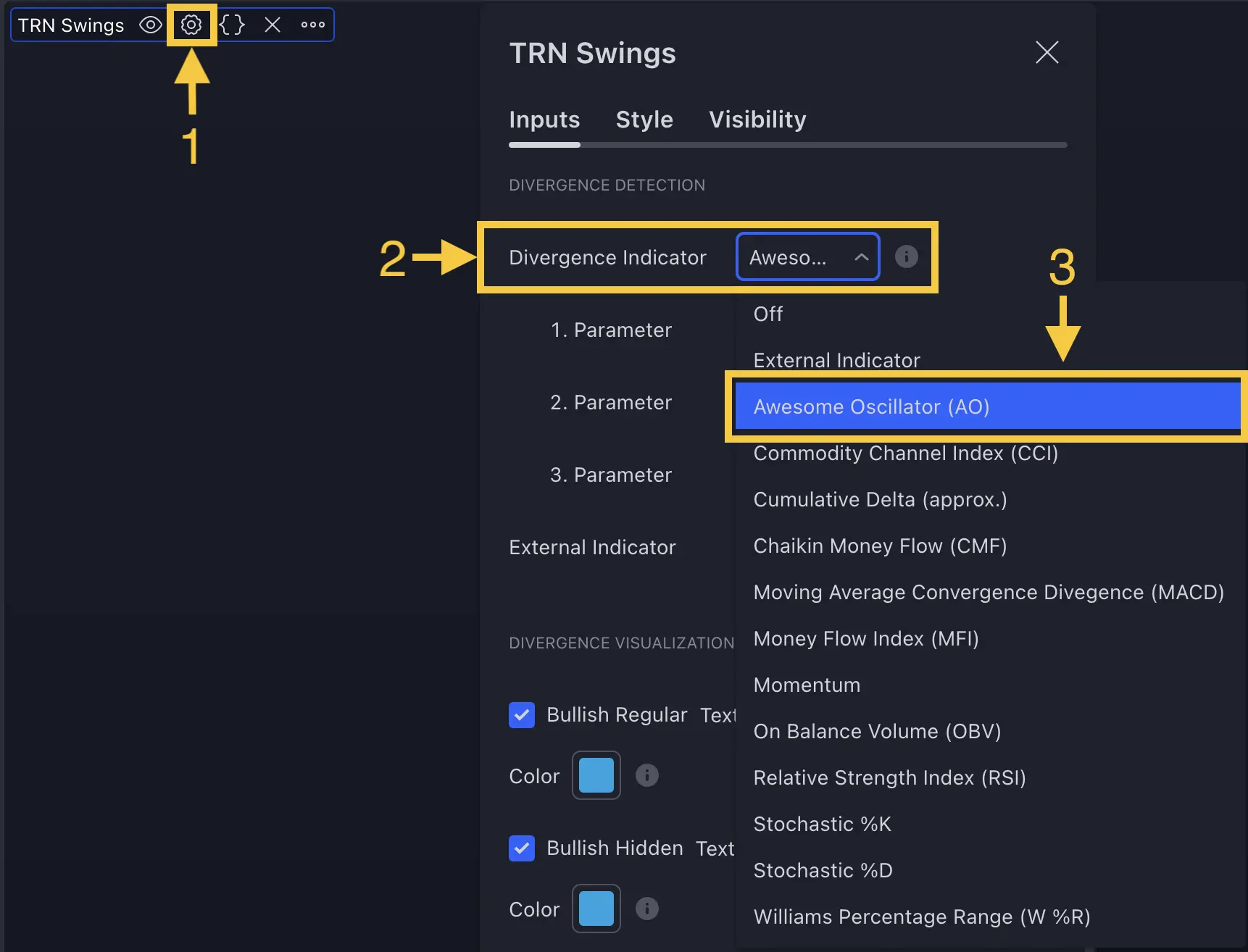
Swing Suite vs. SMT/Divergence Suite Oscillators
The Swing Suite oscillator set overlaps significantly with the SMT/Divergence Suite, with two key differences. The Swing Suite combines Stochastic %K and %D into a single "Double Stochastic %K %D" entry rather than offering them as separate choices. The Swing Suite also includes Cumulative Delta as a built-in oscillator, whereas in the SMT/Divergence Suite it appears in the same list but the Swing Suite adds CDV-specific swing value integration.
The core distinction is architectural: Swing Suite oscillators are part of the integrated swing analysis pipeline. Divergences in the Swing Suite are anchored to confirmed zig-zag swing points, whereas the SMT/Divergence Suite operates its own detection independently of swing structure.
Value Condition Filters
The Swing Suite provides value condition filters on supported oscillators (CCI, RSI, and other bounded oscillators). Value conditions restrict divergence detection to specific oscillator zones, reducing low-quality divergences that occur in neutral territory.
| Value Condition | Behavior |
|---|---|
| Anytime | The Swing Suite detects divergences regardless of oscillator value |
| Above OB | Divergence only detected when oscillator is above the overbought threshold |
| Below OS | Divergence only detected when oscillator is below the oversold threshold |
| Between | Divergence only detected when oscillator is between OB and OS thresholds |
Point Matching
Point matching controls which end of the divergence line must satisfy the value condition. The Swing Suite offers three modes:
| Point Matching | Behavior |
|---|---|
| Only Start | The value condition must be met at the starting swing point of the divergence |
| Only End | The value condition must be met at the ending swing point of the divergence |
| Both | The value condition must be met at both the start and end swing points |
Using "Both" with "Below OS" on RSI, for example, ensures the Swing Suite only flags bullish divergences where RSI was oversold at both swing lows — a strict but high-conviction filter.
Momentum-Based Oscillators
RSI (Relative Strength Index)
The most widely used oscillator for divergence detection. The Swing Suite RSI supports configurable length, smoothing type, and overbought/oversold thresholds. RSI in the Swing Suite also supports value condition and point matching filters.
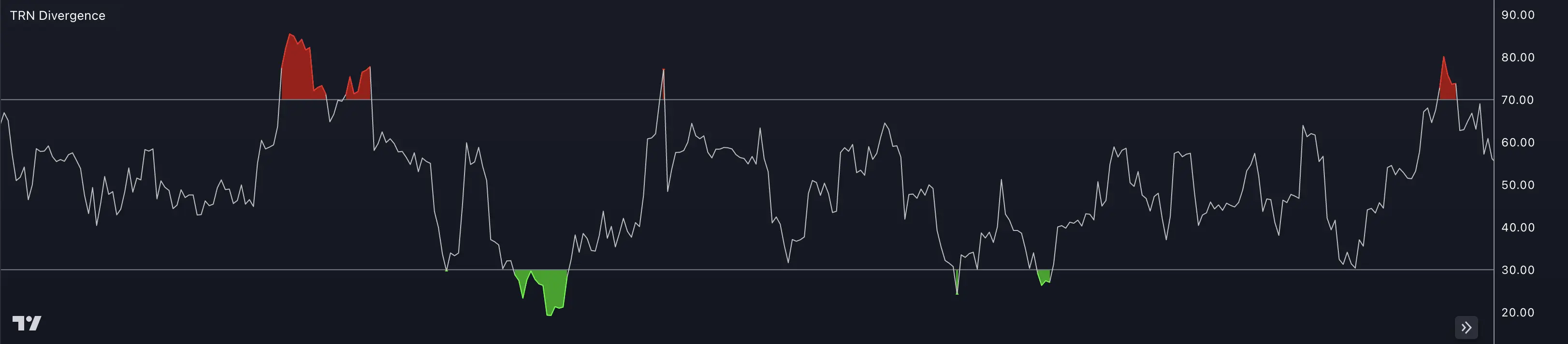
Key Parameters: Length, Smoothing Type, Smoothing Length, OB Limit, OS Limit, Value Condition, Point Matching
MACD (Moving Average Convergence Divergence)
MACD detects momentum shifts by comparing two moving averages. The Swing Suite displays MACD as a histogram with signal line, and the divergence engine identifies divergences between price swing points and MACD histogram peaks/troughs.
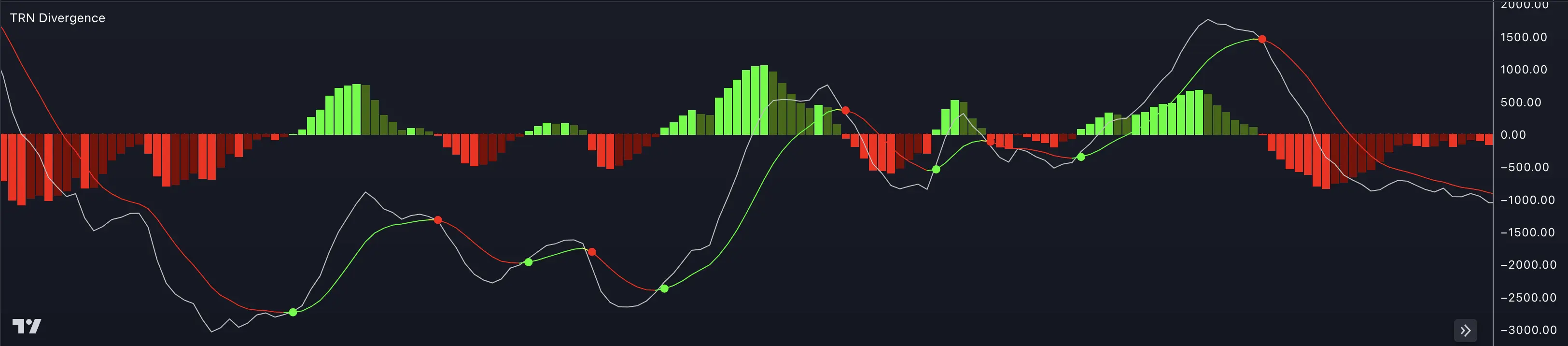
Key Parameters: Fast Length, Slow Length, Signal Length
Double Stochastic %K %D
The Swing Suite combines Stochastic %K and %D into a single oscillator entry. The combined Stochastic in the Swing Suite uses both the fast %K and smooth %D lines, giving traders access to both speed and smoothness within one oscillator selection.
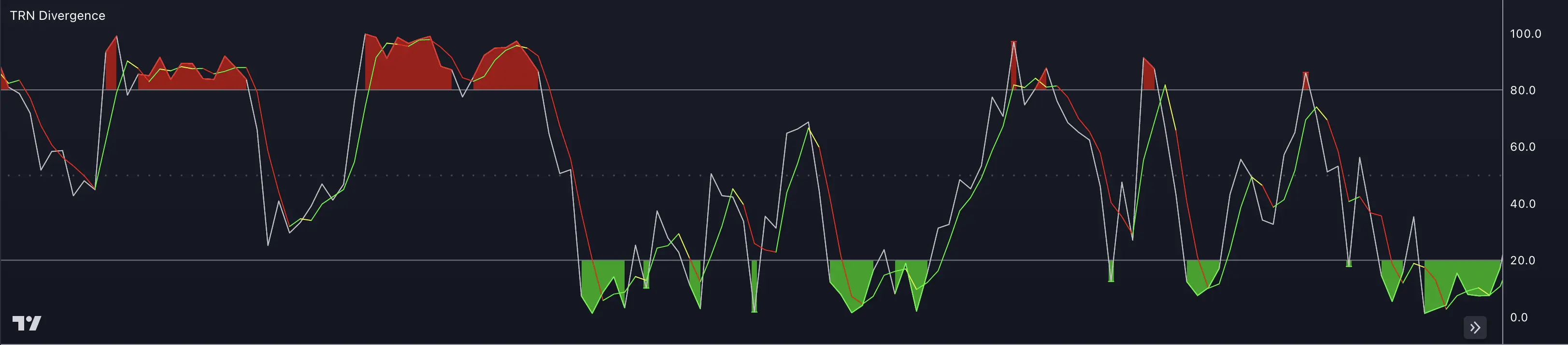
Key Parameters: %K Length, %K Smoothing, %D Length, High Limit, Low Limit
CCI (Commodity Channel Index)
CCI measures price deviation from its statistical average. The Swing Suite CCI supports value condition filters — restricting divergence detection to overbought zones, oversold zones, or the range between them. CCI also supports point matching for precise filtering.
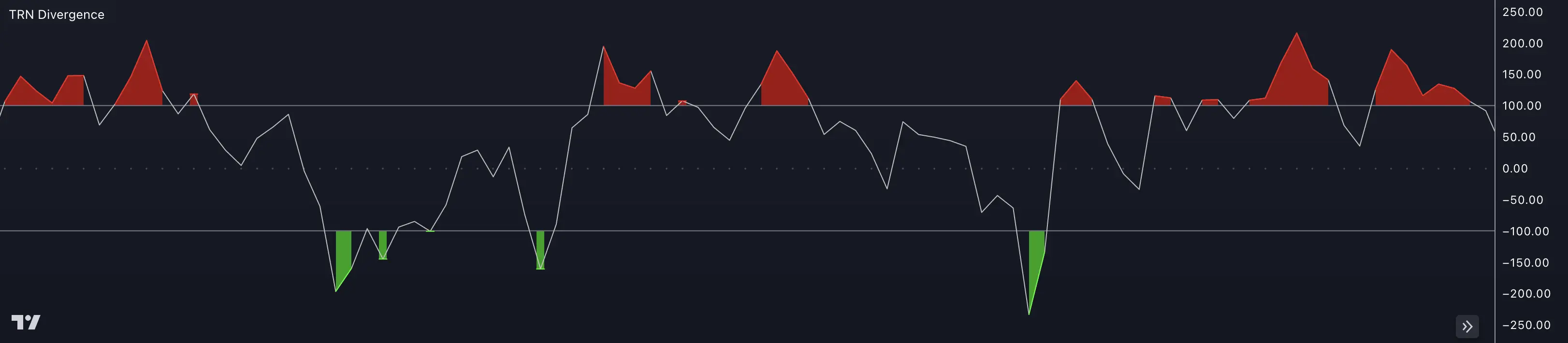
Key Parameters: Length, OB Limit, OS Limit, Value Condition, Point Matching
Williams %R
An inverted momentum oscillator ranging from 0 to -100. The Swing Suite applies divergence detection with inverted threshold logic — values near 0 indicate overbought, values near -100 indicate oversold.
Key Parameters: Length, High Limit, Middle Limit, Low Limit
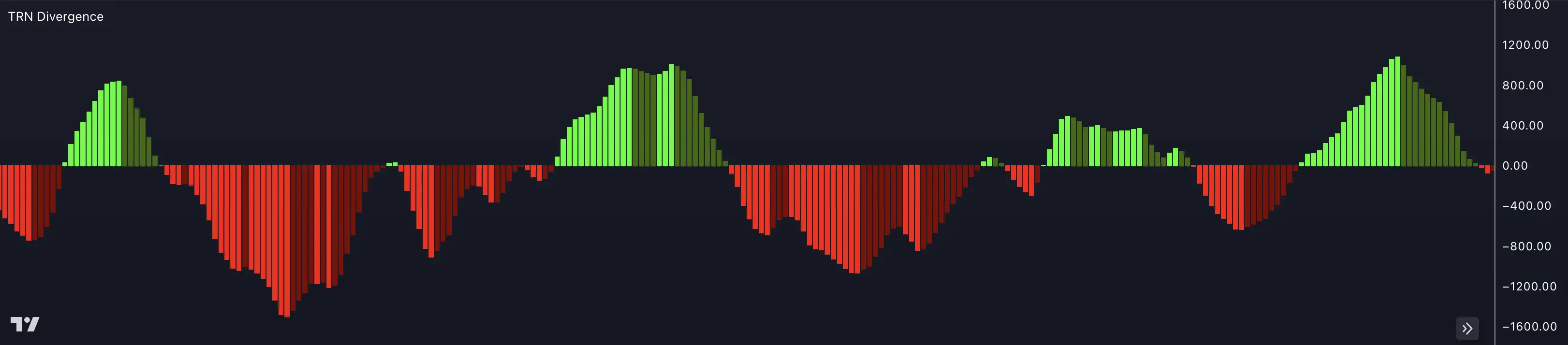
Awesome Oscillator (AO)
AO measures momentum as the difference between short and long moving averages of median price. The Swing Suite displays AO as a color-coded histogram — green bars for rising momentum, red for falling — making divergence patterns visually clear.
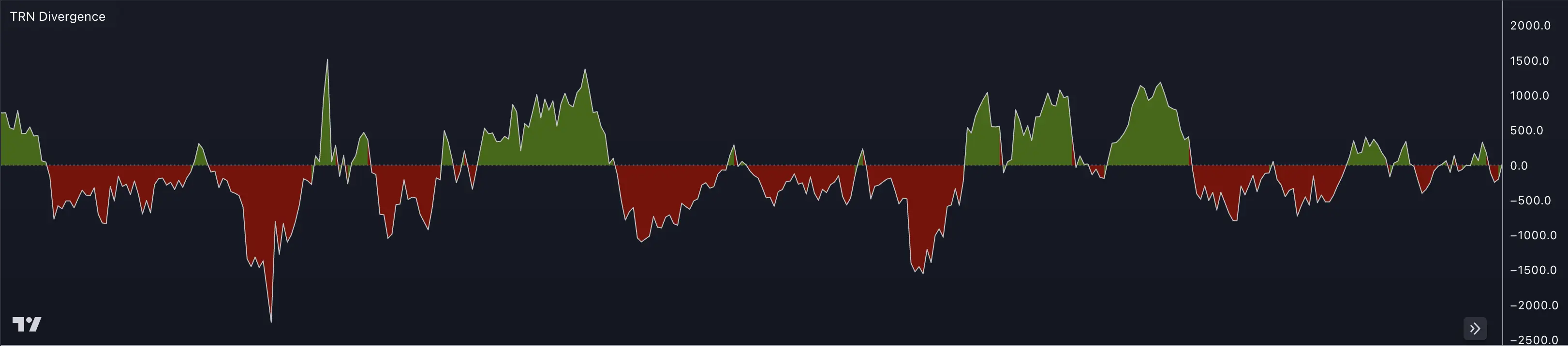
Momentum
A rate-of-change oscillator measuring price difference over a lookback period. The Swing Suite uses Momentum for straightforward divergence detection without bounded thresholds — suitable when traders want raw momentum comparison between swing points.
Key Parameters: Length
Volume-Based Oscillators
Volume-based oscillators require instruments with reliable volume data — typically futures, crypto, and stocks. Forex pairs from most brokers lack true volume, which limits the effectiveness of these oscillators in the Swing Suite.
Cumulative Delta (approx.)
Cumulative Delta approximates net buying versus selling volume by analyzing lower-timeframe price-volume relationships. The Swing Suite integrates CDV deeply — cumulative delta values also appear in the swing values display (absolute and relative modes), making CDV the only oscillator with both divergence detection and per-swing metric reporting.
Cumulative Delta divergence at confirmed Swing Suite swing points is one of the highest-conviction setups. When price makes a lower low but CDV makes a higher low at a confirmed swing, institutional buying is absorbing selling pressure — a structural divergence that carries more weight than oscillator-only divergences.
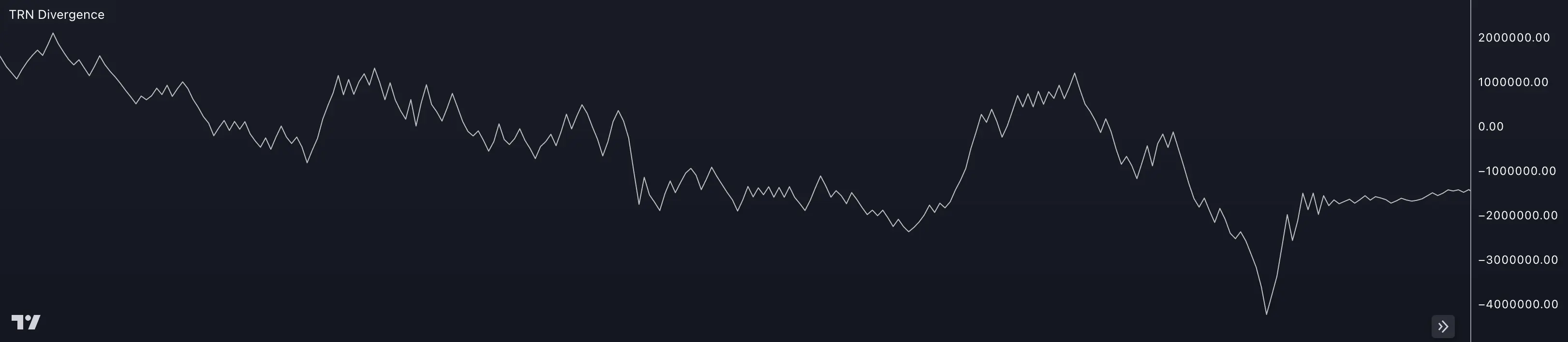
OBV (On Balance Volume)
OBV accumulates volume on up-close bars and subtracts on down-close bars. Divergence between OBV and price at Swing Suite swing points reveals whether volume supports or contradicts the current structural trend.
CMF (Chaikin Money Flow)
CMF measures accumulation and distribution of money flow over a configurable period. The Swing Suite displays CMF with a zero-line fill for quick visual assessment of buying versus selling pressure.
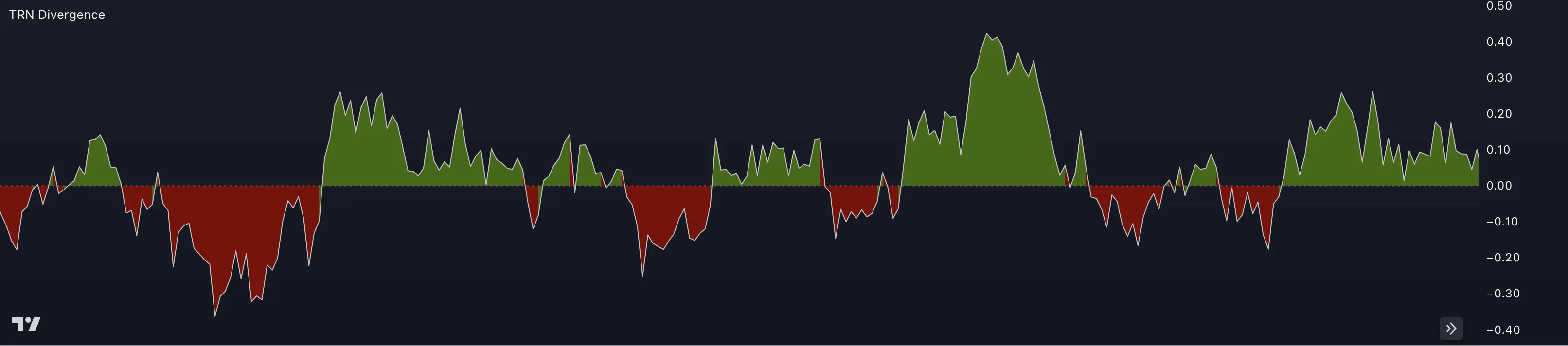
Key Parameters: Length
MFI (Money Flow Index)
MFI combines price and volume into a bounded oscillator (0–100), often described as the volume-weighted RSI. The Swing Suite applies configurable overbought, middle, and oversold thresholds for MFI-based divergence detection.
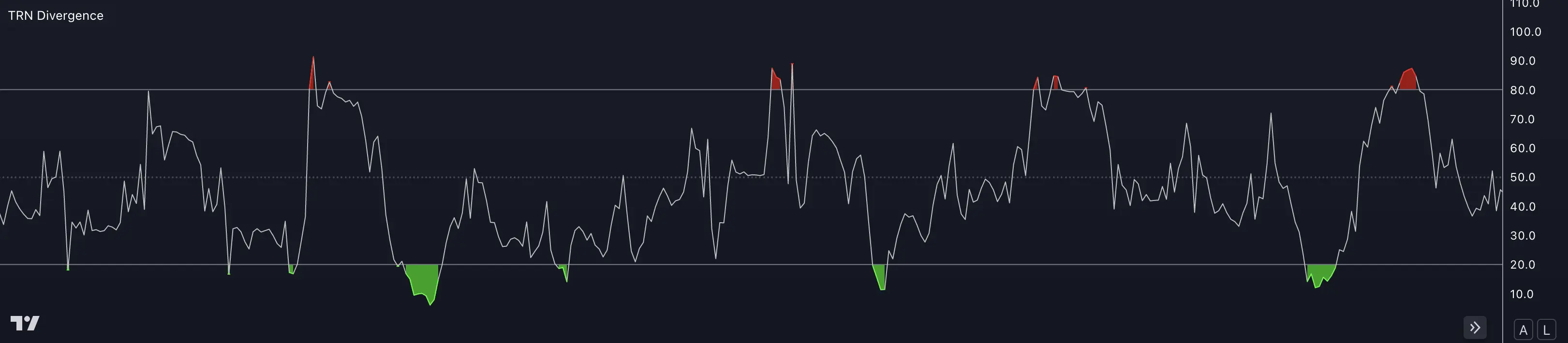
Key Parameters: Length, High Limit, Middle Limit, Low Limit
FAQ
How do the Swing Suite built-in oscillators differ from the SMT/Divergence Suite oscillators?
The Swing Suite includes 11 built-in oscillators compared to 13 in the SMT/Divergence Suite. The Swing Suite combines Stochastic %K and %D into a single "Double Stochastic %K %D" entry and adds Cumulative Delta as a built-in oscillator. In the Swing Suite, oscillators integrate directly with the swing-based zig-zag detection engine — divergences are identified at confirmed swing points rather than independently.
What are value conditions and point matching in the Swing Suite oscillator settings?
Value conditions in the Swing Suite filter divergence detection by oscillator zone — Above OB (overbought), Below OS (oversold), Between OB and OS, or Anytime. Point matching controls which divergence points must meet the value condition — Only Start, Only End, or Both. These filters help the Swing Suite reduce false divergences by requiring oscillator readings in specific zones.
Which Swing Suite oscillator works best for divergence detection on futures?
Cumulative Delta is the strongest choice for futures divergence in the Swing Suite because futures provide reliable volume data. When the Swing Suite detects a price swing making a new low while Cumulative Delta makes a higher low, the divergence reveals institutional buying pressure absorbing selling — a high-conviction structural signal.
Can I use an external indicator instead of the Swing Suite built-in oscillators?
Yes. The Swing Suite supports custom indicator connections for divergence detection. Any TradingView indicator that produces a plot can be linked to the Swing Suite divergence engine. See the Custom Indicator guide for setup instructions.