Trading Strategies
The SMT/Divergence Suite detects divergences — but divergences alone are not trade signals. The strategies below combine SMT/Divergence Suite signals with entry confirmation from other TRN indicators to create complete trade workflows with defined entries, stops, and targets.
Strategy 1: Regular Divergence Reversal
Regular divergences signal potential trend reversals. The SMT/Divergence Suite identifies when momentum weakens against the current trend, and Trend Bars Pro confirms the reversal with a signal bar.
Bullish Setup
- The SMT/Divergence Suite shows a confirmed regular bullish divergence — price makes a lower low while the oscillator makes a higher low
- Wait for a bullish reversal bar from Trend Bars Pro on the same or next bar
- Enter long on the close of the reversal bar
- Place stop loss below the swing low that formed the divergence
- Target the previous swing high or a Swing Suite support/resistance level
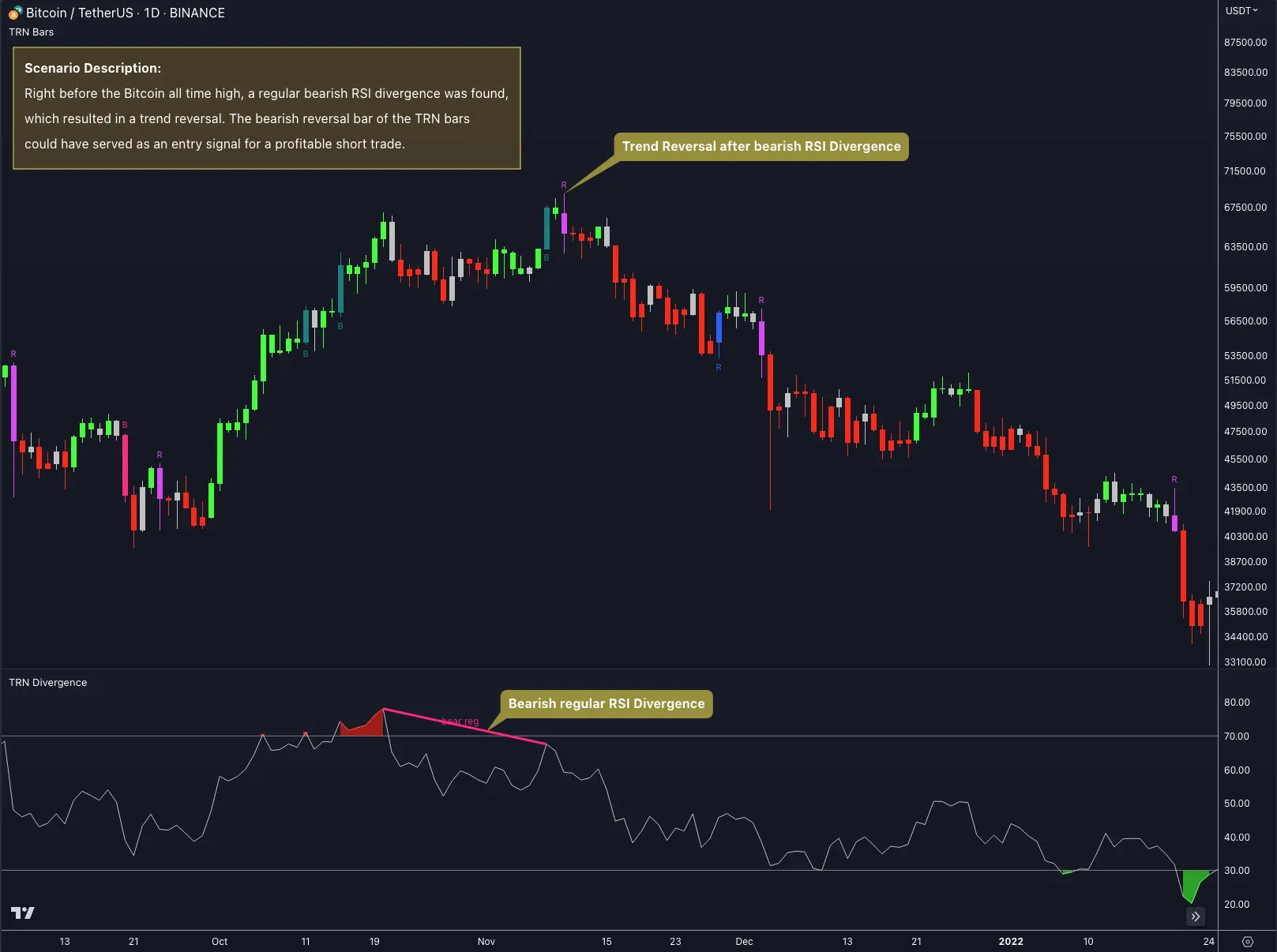
Bearish Setup
- The SMT/Divergence Suite shows a confirmed regular bearish divergence — price makes a higher high while the oscillator makes a lower high
- Wait for a bearish reversal bar from Trend Bars Pro
- Enter short on the close of the reversal bar
- Place stop loss above the swing high that formed the divergence
- Target the previous swing low or a support level
Regular divergences in the SMT/Divergence Suite are strongest when they form at Price Action Suite key levels — previous day high/low, weekly levels, or session boundaries. A divergence at a structural level has more predictive power than one in the middle of a range.
Strategy 2: Hidden Divergence Continuation
Hidden divergences signal trend continuation with underlying strength. The SMT/Divergence Suite identifies when the oscillator dips against the trend while price holds structure.
Bullish Continuation
- The SMT/Divergence Suite shows a confirmed hidden bullish divergence — price makes a higher low while the oscillator makes a lower low
- Confirm the uptrend is intact using Swing Suite swing trend (bullish swing structure)
- Wait for a bullish signal bar from Trend Bars Pro (continuation bar or reversal bar)
- Enter long on the close of the signal bar
- Place stop loss below the higher low that formed the divergence
- Target the previous swing high or a measured move
Bearish Continuation
- The SMT/Divergence Suite shows a confirmed hidden bearish divergence
- Confirm the downtrend with Swing Suite (bearish swing structure)
- Wait for a bearish signal bar from Trend Bars Pro
- Enter short with stop above the lower high
Strategy 3: SMT Divergence Trade
SMT divergence adds an institutional dimension that single-instrument analysis misses. When correlated instruments disagree on structure, it often signals larger positioning shifts.
Setup
- The Trend and Reversal Scanner flags a divergence on an instrument
- Open the SMT/Divergence Suite on that instrument's chart
- Switch to SMT Symbol mode and set the reference symbol (e.g., ES for NQ, or ETHUSDT for BTCUSDT)
- Look for confirmed SMT divergence — one instrument makes a new high/low while the correlated instrument fails to confirm
- Use Trend Bars Pro for entry confirmation and Price Action Suite market structure for context
Key Principle
When the SMT/Divergence Suite shows that a correlated instrument refuses to confirm a new extreme, the move is likely running on retail momentum rather than institutional conviction. The failure to confirm suggests the trend may reverse.
Risk Management
Stop Placement
The SMT/Divergence Suite works best with structure-based stops tied to the divergence swing points:
- Regular divergence: Stop below the swing low (bullish) or above the swing high (bearish) that formed the divergence
- Hidden divergence: Stop below the higher low (bullish) or above the lower high (bearish)
- SMT divergence: Stop below the most recent swing low on both correlated instruments
Position Sizing
- Risk 1–2% of account equity per trade
- Calculate position size from the distance between entry and stop
- Tighter divergence swings allow larger position sizes with the same risk
When to Avoid Divergence Trades
- During high-impact news events — divergences can form and invalidate rapidly
- On instruments with low liquidity or unreliable volume (volume-based oscillators may produce false divergence signals)
- When the Swing Suite shows no clear trend structure — divergences in choppy markets are less reliable
FAQ
How do I trade a regular bullish divergence with the SMT/Divergence Suite?
When the SMT/Divergence Suite detects a confirmed regular bullish divergence, wait for a bullish reversal bar from Trend Bars Pro or a break of structure from Price Action Suite before entering long. Place a stop loss below the most recent swing low. The divergence shows weakening selling pressure — the entry confirmation reduces the risk of premature entries on divergences that don't lead to reversals.
What is the best risk management approach for divergence trading?
The SMT/Divergence Suite works best with structure-based stop placement rather than fixed-pip stops. Place stops below the swing low (for bullish) or above the swing high (for bearish) that formed the divergence. Use Swing Suite support and resistance levels for target placement. Risk no more than 1-2% of account equity per divergence trade.
Can I combine SMT divergence with regular oscillator divergence?
Yes, combining both in the SMT/Divergence Suite is a powerful approach. First check the Trend and Reversal Scanner for oscillator divergence across your watchlist. Then open the SMT/Divergence Suite on the flagged instrument and switch to SMT mode to check if correlated instruments confirm or contradict the signal. A divergence confirmed by both oscillator and SMT analysis has higher conviction.