Order Blocks — Institutional Supply and Demand Zones
Order Blocks mark the zones where institutional participants placed significant orders before a strong price move. Price Action Suite detects these zones across multiple timeframes and layers Cumulative Volume Delta on each block, giving traders a volume-confirmed view of where supply and demand are concentrated.
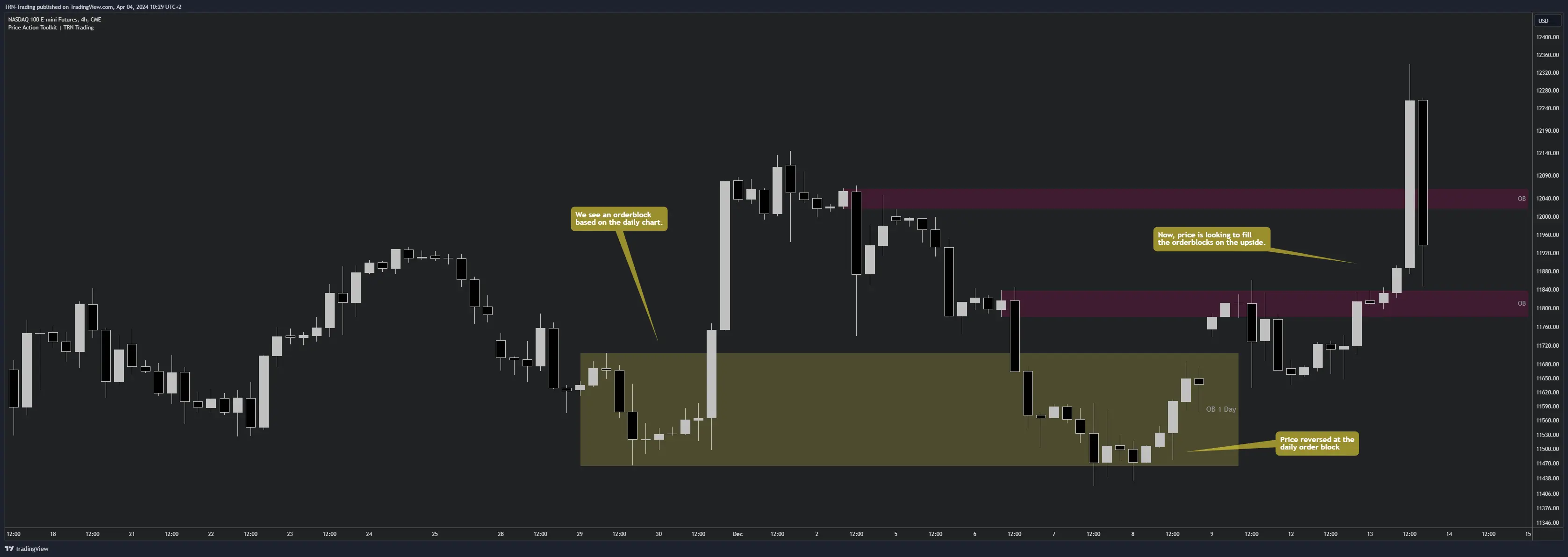
Order Blocks complement Fair Value Gaps by identifying the origin point of imbalanced moves rather than the gap left behind. Together, these two features map both where institutional orders were placed and the structural imbalance those orders created.
How Order Blocks Form
An Order Block is the last opposing candle before a strong directional impulse. The logic is straightforward: institutional participants need to accumulate or distribute positions, and the final opposing candle before the move represents the zone where that accumulation or distribution completed.
Bullish Order Block: The last bearish (red/down) candle before a strong bullish impulse. This candle marks the zone where institutional buying absorbed the remaining sell-side liquidity. When price returns to this zone, the same demand that launched the original move may produce another reaction.
Bearish Order Block: The last bullish (green/up) candle before a strong bearish impulse. This candle represents the zone where institutional selling overwhelmed buyers. A return to this zone may trigger another supply-driven move lower.
The body of the opposing candle defines the Order Block zone. Price Action Suite draws the block from the open to the close of that candle, extending it forward until the block is either filled or expires.
How Order Blocks Resolve
Order Blocks behave as reactive zones. When price returns to a bullish Order Block, traders watch for a bounce or demand response. When price returns to a bearish Order Block, a rejection or supply response is the expected behavior.
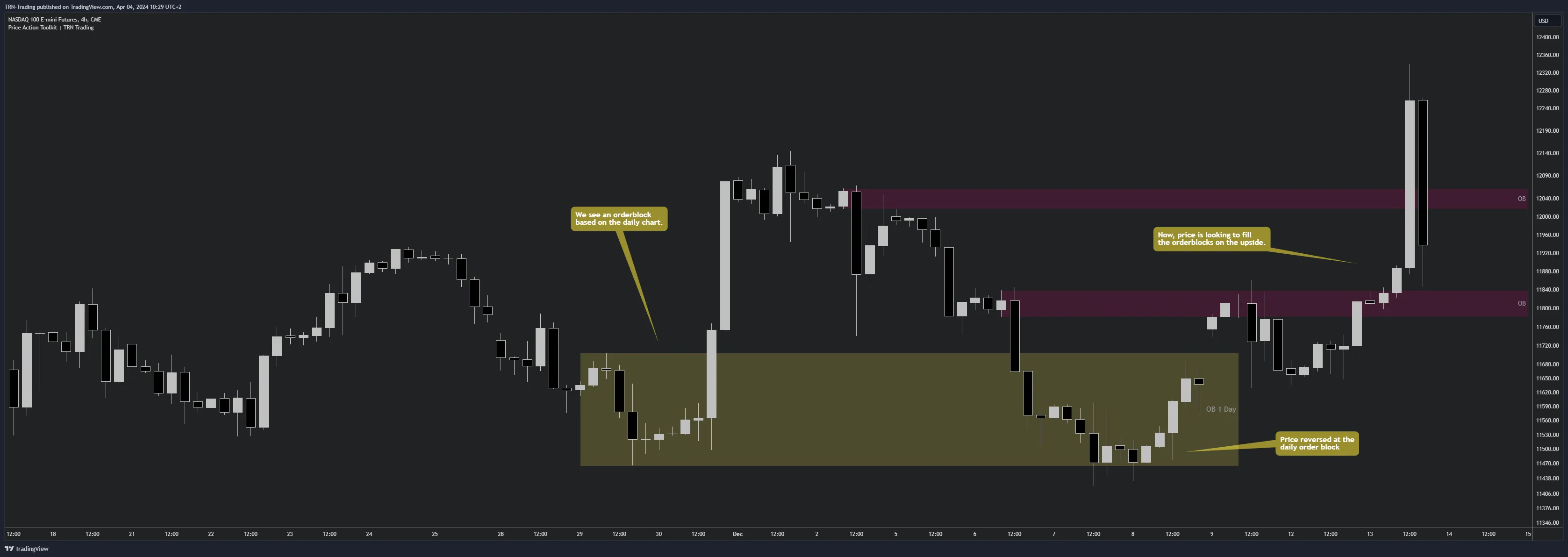
Price Action Suite manages Order Block lifecycle automatically:
- Invalidation by fill — When price trades completely through the Order Block zone, the block is removed. The institutional supply or demand at that level has been absorbed.
- Expiration by duration — Order Blocks that exceed the configured maximum duration (default 100 bars) without a revisit are removed. Stale zones lose relevance as market conditions evolve.
The middle line within each Order Block provides a reference for partial reactions. Some traders treat a reaction at the midpoint as sufficient structural confirmation even when price does not reach the full extent of the zone.
Multi-Timeframe Order Blocks
Price Action Suite displays Order Blocks from three timeframes simultaneously:
- Chart Timeframe — Blocks detected on the current chart resolution.
- Timeframe 1 (TF1) — Defaults to 4H. Configurable to any higher timeframe.
- Timeframe 2 (TF2) — Defaults to 1D. Configurable to any higher timeframe.
Each timeframe has independent up/down color settings. Labels on higher-timeframe blocks identify their source, so traders can immediately distinguish a daily Order Block from a chart-timeframe block on a 15-minute chart. Higher-timeframe Order Blocks generally produce stronger reactions because they represent larger institutional positioning.
An Order Block gains structural weight when it overlaps with a Fair Value Gap from the same or higher timeframe. A daily bullish Order Block sitting at the same level as a 4H bullish FVG creates a high-confluence demand zone that combines two independent structural signals.
Cumulative Volume Delta on Order Blocks
Cumulative Volume Delta reveals the volume composition within each Order Block zone. Not all blocks are created equal — CVD helps traders rank them by institutional conviction.
Each Order Block displays CVD in two components:
- Volume bars (left side) — Green bar represents cumulative buying volume, red bar represents cumulative selling volume within the block zone.
- Volume ratio (right side) — Buy-to-sell volume ratio. A ratio above 1 (for example 1.4) indicates net buying pressure. A ratio below 1 (for example 0.7) indicates net selling pressure.
For a bullish Order Block, a CVD ratio above 1 confirms that buyers dominated the zone despite the candle closing bearish — strong evidence of institutional accumulation. For a bearish Order Block, a CVD ratio below 1 confirms selling dominance within the zone.
CVD display modes are configurable: Off, Boxes + Ratios, Boxes only, or Ratios only. Traders can adjust the display to balance information density with chart readability.
Order Block Settings Reference
| Setting | Default | Description |
|---|---|---|
| Max Duration | 100 bars | Order Blocks older than this value are automatically removed |
| Max Occurrences | 25 | Maximum number of Order Blocks displayed per timeframe |
| Middle Line | Toggle | Shows the midpoint within each block with configurable color and style |
| CVD Display | Off | Options: Off, Boxes + Ratios, Boxes only, Ratios only |
| Labels | Toggle | Show/hide OB labels with timeframe identification, configurable color and size |
| Historic OBs | Toggle | When enabled, expired blocks repaint to their original size for historical review |
Each of the three timeframes (Chart, TF1, TF2) has its own toggle and independent up/down color settings for clear visual separation.
Order Blocks vs. Fair Value Gaps
Both features identify structural zones, but they capture different aspects of institutional activity:
| Order Blocks | Fair Value Gaps | |
|---|---|---|
| What it marks | Origin of the move — the last opposing candle | Consequence of the move — the gap left behind |
| Zone definition | Candle body (open to close) | Wick gap between candle 1 and candle 3 |
| Best use | Identifying where institutions positioned | Identifying where price skipped and may return |
| Strongest when | Aligned with HTF FVG or market structure shift | Aligned with HTF OB or important levels |
Using both features together provides a more complete structural map than either feature alone.
FAQ
What is an Order Block in trading?
An Order Block is the last opposing candle before a strong directional move. A bullish Order Block is the final bearish candle before a bullish impulse, marking a zone where institutional buying absorbed the remaining sell orders. A bearish Order Block is the last bullish candle before a bearish impulse. These zones frequently act as support or resistance when price returns to them.
How does multi-timeframe Order Block analysis work?
Price Action Suite detects Order Blocks on three simultaneous timeframes — the chart timeframe plus two configurable higher timeframes (TF1 defaults to 4H, TF2 defaults to 1D). Each timeframe uses independent colors and labels, allowing traders to see daily and 4-hour Order Blocks directly on a lower-timeframe execution chart.
When is an Order Block considered invalidated?
Price Action Suite removes an Order Block when price fully fills through the zone, meaning the imbalance has been absorbed. Order Blocks also expire when they exceed the configured maximum duration in bars, which defaults to 100. Traders can adjust both settings to match their trading timeframe.
How does CVD enhance Order Block analysis?
Cumulative Volume Delta shows the net buying and selling pressure within each Order Block zone. A ratio above 1 indicates buying dominance while a ratio below 1 indicates selling pressure. This volume layer helps traders distinguish between high-conviction institutional zones and weaker blocks that may not produce a meaningful reaction.