Bar Range Detection
Bar Range detection in TRN Trend Bars Pro identifies consolidation zones where price contracts before making a directional move. The feature draws visual boundaries around these ranges, tracks their lifecycle, and confirms breakouts — giving traders a structured framework for trading range-bound markets and breakout entries.
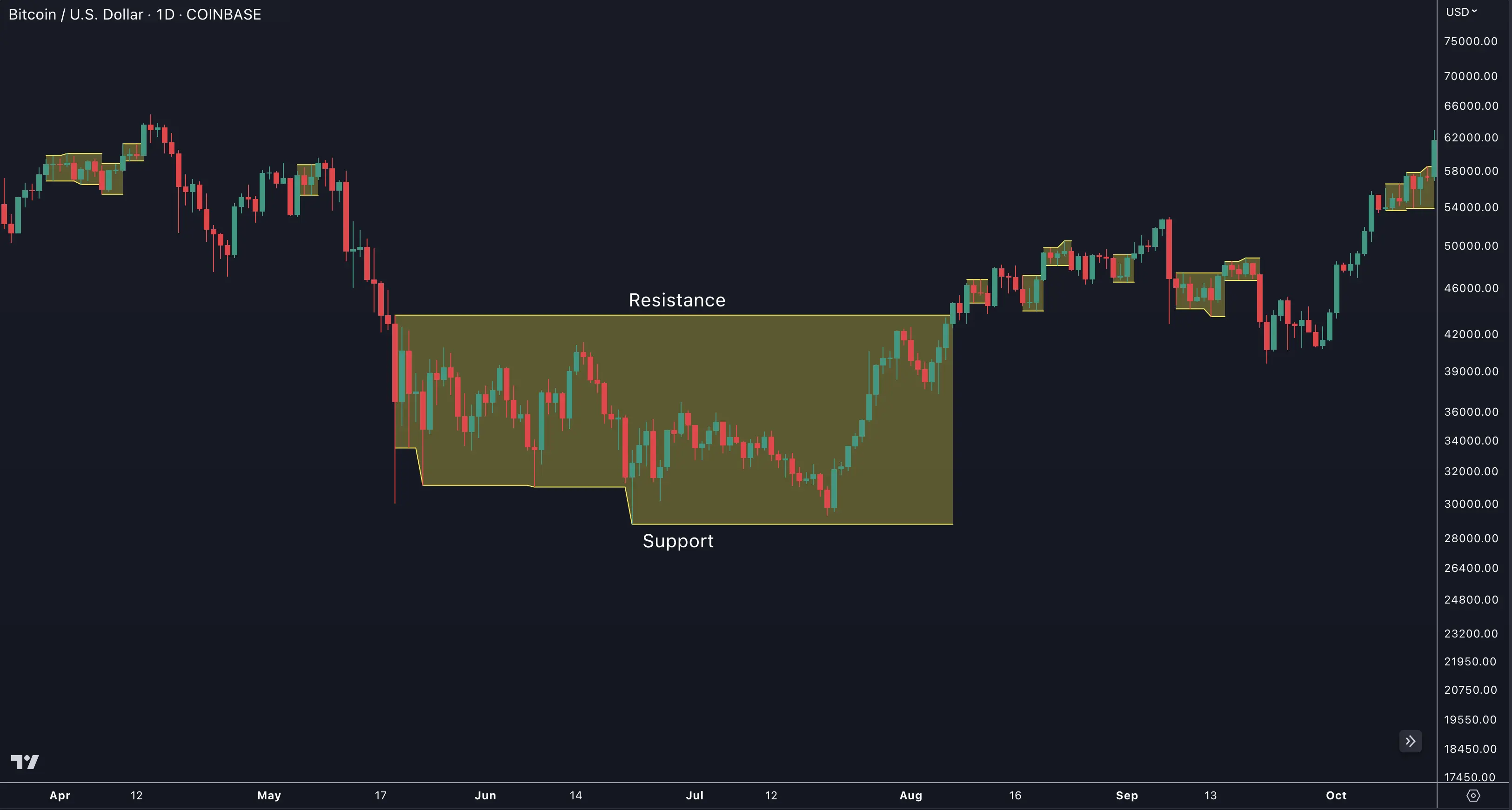
Range Lifecycle
Bar Range detection operates through four distinct stages. Understanding each stage helps traders anticipate breakout opportunities rather than react to them.
Searching
The system continuously scans price action for consolidation patterns. During this phase, no range is drawn on the chart. Trend Bars Pro monitors bar behavior to detect when price begins contracting into a defined zone.
Active
Once a consolidation pattern is identified, the range becomes active. Yellow boundary lines mark the support and resistance levels of the zone, and a filled area between the lines highlights the consolidation region. Price is expected to oscillate within these boundaries while the range remains active.
Breakout
When price breaks through a range boundary, the breakout stage begins. The boundary has been violated, but the breakout is not yet confirmed. This intermediate stage filters premature entries that occur when price briefly pierces a boundary only to return inside the range.
Confirmed
Confirmation occurs when a bar closes beyond the range boundary. At this point, Trend Bars Pro fires a Breakout Bar (B) signal, indicating a valid trading opportunity. Confirmed breakouts carry significantly more weight than intrabar boundary touches.
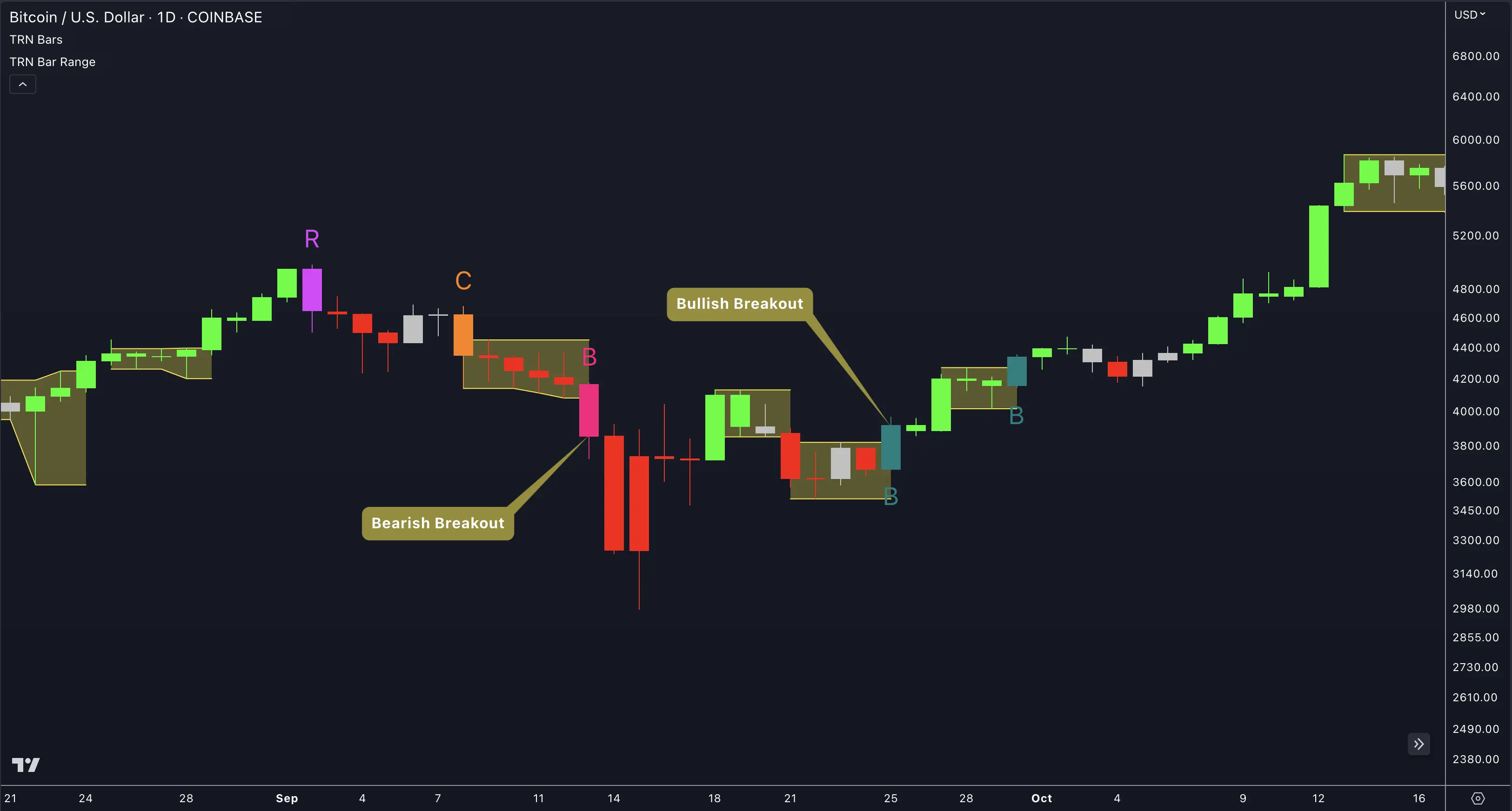
Trading with Bar Range
Breakout Entries
The confirmed breakout is the primary trade setup from Bar Range detection. When a Breakout Bar fires after range confirmation, traders can enter in the breakout direction with defined risk.
- Bullish breakout: Enter long on confirmed close above range resistance
- Bearish breakout: Enter short on confirmed close below range support
Combine breakout entries with Dynamic Trend direction to filter breakouts that align with the prevailing trend.
Stop Placement
Range boundaries provide natural stop-loss levels because they represent tested support and resistance:
- Long entries: Place stops below the range low (support boundary)
- Short entries: Place stops above the range high (resistance boundary)
This approach keeps risk defined and tied to the structural level that must hold for the trade thesis to remain valid.
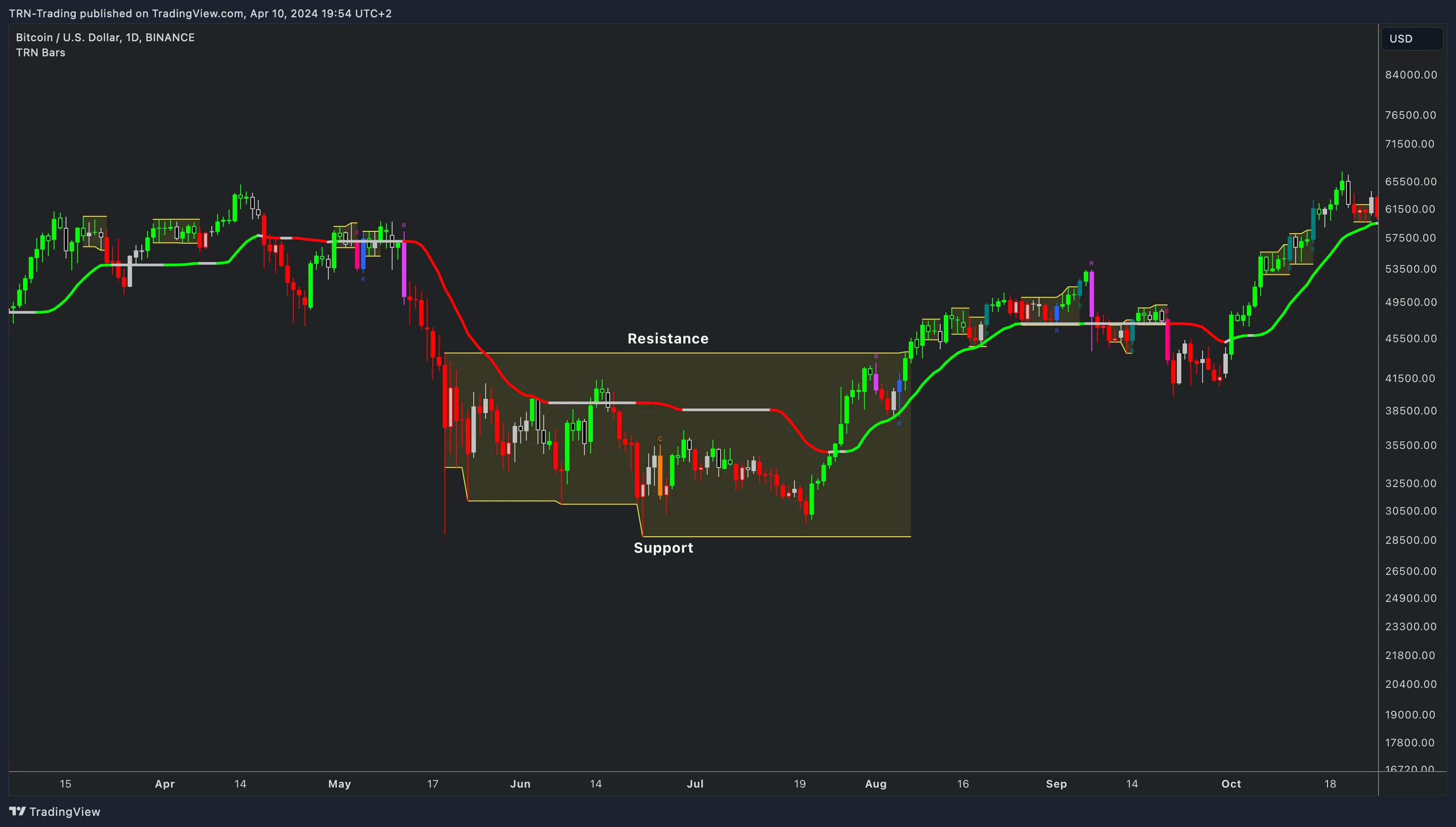
Consolidation Identification
Active ranges highlight periods where the market is building energy for a directional move. Recognizing consolidation early allows traders to prepare entries before the breakout occurs rather than chasing price after the fact.
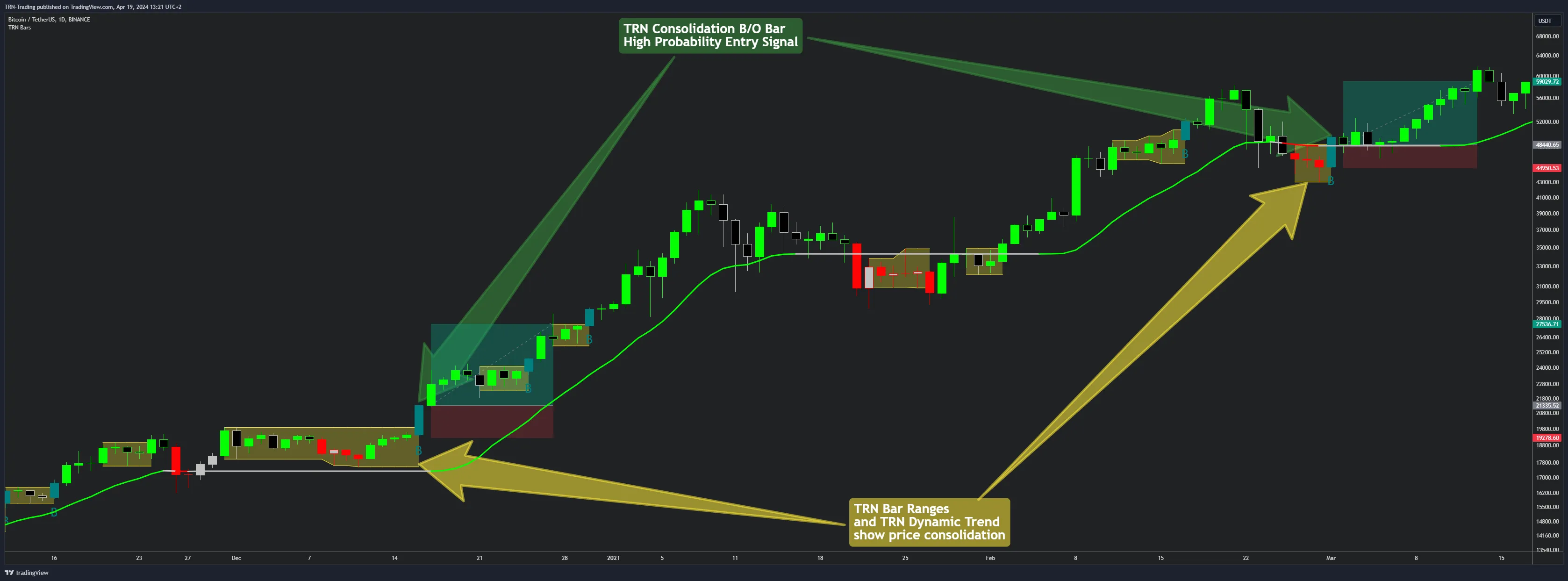
Combine range breakouts with Signal Bars for multi-factor confirmation. A Breakout Bar that coincides with a Continuation or Reversal signal in the breakout direction represents a higher-probability setup.
Bar Range Settings
Customize the Bar Range display to match your chart preferences:
- Plot One Bar Ahead: Shifts the range visualization forward by one bar, making it easier to see where the current range boundary sits relative to developing price action
- Range Color: Controls the color of range boundary lines (default: yellow #FFFF00)
- Line Width: Adjusts the thickness of range boundary lines for visibility
- Fill Color: Sets the color used to fill the area between range boundaries
- Transparency: Controls fill opacity from 0 (fully opaque) to 100 (fully transparent)
Configure alerts for Breakout Bar signals to receive notifications when confirmed range breakouts occur across your watchlist.
FAQ
How does Bar Range detection identify consolidation zones?
Bar Range detection scans price action for consolidation patterns where price contracts into a defined zone. Once the range is established, yellow boundary lines mark support and resistance levels. The filled zone between these lines highlights the consolidation area on your chart in real time.
When does a range breakout become a confirmed trading signal?
A range breakout follows a four-stage lifecycle. First, the system searches for a consolidation pattern. Once found, the range becomes active with defined boundaries. When price breaks a boundary, the breakout state begins. Confirmation occurs on bar close beyond the range, producing a valid Breakout Bar (B) signal you can act on.
What is the best way to use Bar Range for stop placement?
For long entries after a bullish breakout, place your stop below the range low. For short entries after a bearish breakout, place your stop above the range high. The range boundaries represent tested support and resistance, making them natural invalidation levels that keep your risk defined and measurable.
Can I combine Bar Range with other Trend Bars Pro features?
Bar Range works best when combined with Signal Bars for entry confirmation and Dynamic Trend for directional bias. A breakout bar appearing alongside a trend-aligned signal bar and a supportive Dynamic Trend direction creates a high-conviction setup with multiple layers of confirmation.