Opening Range Pro Trading Strategies
Opening Range Pro provides the session-level bias framework that guides which Trend Bars Pro entries to take and which to skip. These strategies combine Opening Range Pro levels with other TRN indicators for complete trade workflows.
Opening Range Pro fills the Bias role: Context (Price Action Suite) → Bias (Opening Range Pro) → Structure (Swing Suite) → Entry (Trend Bars Pro).
Strategy 1: OR Breakout
The highest-probability Opening Range Pro strategy. Wait for the defining range to complete, then trade the directional breakout.
Bullish Breakout
- Opening Range Pro defining range completes — OR levels lock in
- Price breaks above OR High (wick-based level)
- Confirm with Trend Bars Pro bullish signal bar or green Dynamic Trend
- Enter long on the confirmed breakout bar
- Stop: Below OR Low
- Target: +1.0 SD level (typical session move) or +1.5 SD for extended targets
Bearish Breakout
- Price breaks below OR Low
- Confirm with Trend Bars Pro bearish signal bar or red Dynamic Trend
- Enter short on the confirmed breakout bar
- Stop: Above OR High
- Target: -1.0 SD level or -1.5 SD for extended targets
Approximately 90% of sessions breach the opening range, and approximately 80% of the time the opposite side remains untouched after a breakout. This means a stop on the opposite side of the OR is statistically well-placed.
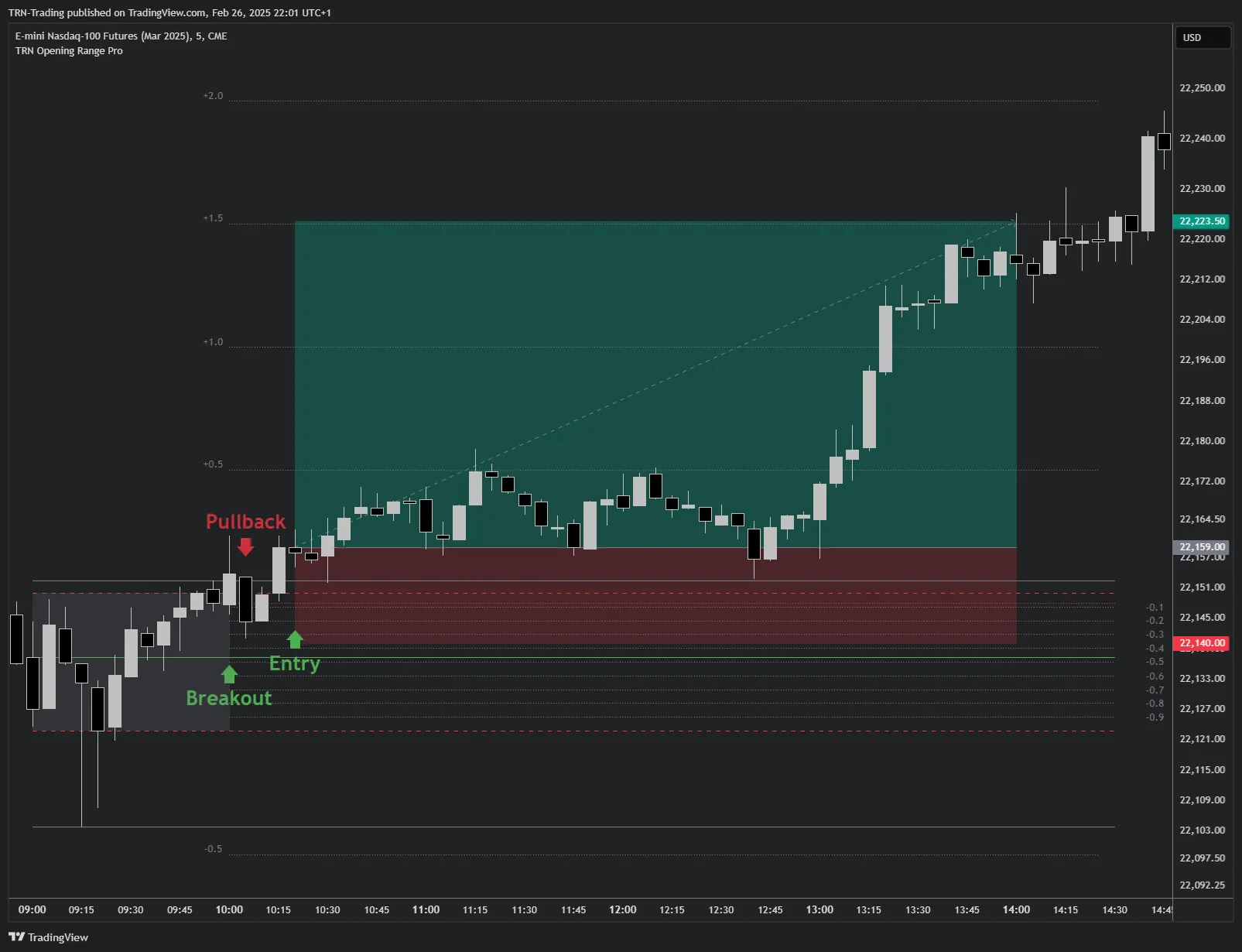
Strategy 2: OR Pullback Entry
A higher-conviction variant that waits for a pullback after the initial breakout.
- Price breaks above OR High (or below OR Low) — establishing session bias
- Wait for price to pull back toward the OR levels — the IOR level or OR Open often acts as support
- Enter when Trend Bars Pro prints a reversal or continuation bar at the pullback level
- Stop: Below the pullback low (tighter than Strategy 1)
- Target: +1.0 SD or higher — the breakout direction is already confirmed
This approach offers a tighter stop and better risk-to-reward than the initial breakout entry, but requires patience and occasionally misses fast moves.
Strategy 3: Multi-Session Confluence
When levels from one session carry forward and align with the next session's OR, the confluence creates high-probability zones.
Example Workflow
- Asia session: Opening Range Pro establishes Asia OR levels
- London session opens: London OR levels form. Check if London OR levels align with Asia OR levels — if Asia OR High coincides with London IOR, that level has double-session significance
- Trade: Enter at confluence levels with Trend Bars Pro confirmation. Use Price Action Suite levels (PDH, PDL, session H/L) as additional confluence
Session Transition Rules
- Asia → London: Asia OR levels often serve as initial support/resistance for London
- London → New York: London OR levels frequently define the New York session's reaction zones
- Session Close levels: Prior session close prices mark gap boundaries and momentum references
Strategy 4: Range-Bound Scalping
When price stays inside the opening range without a clear breakout, Opening Range Pro's inner division levels provide a micro trading grid.
- Enable inner levels (9 divisions within the range)
- Trade bounces between inner levels — long near the 0.8/0.9 levels (support), short near 0.1/0.2 (resistance)
- Use the midpoint (0.5) as the equilibrium target for mean reversion entries
- Exit this approach and switch to the breakout strategy when price closes outside OR High or OR Low
Risk Management
Stop Placement
| Strategy | Stop Location | Rationale |
|---|---|---|
| OR Breakout | Opposite side of OR | Full range invalidation — widest stop but highest statistical backing |
| Pullback Entry | Below pullback low | Tighter stop — pullback failure invalidates the entry |
| Multi-Session | Below confluence level | Double-session level invalidation |
| Range Scalping | Beyond nearest inner level | Micro invalidation within the range |
Target Selection
- SD bands provide the primary targets — use +1.0 SD for conservative exits, +1.5/+2.0 for extended targets
- Price Action Suite levels (PDH/PDL, CWH/CWL) provide structural targets that may align with or override SD targets
- Swing Suite support/resistance provides swing-based targets that complement session-based targets
FAQ
What is the best Opening Range Pro trading strategy for beginners?
The OR Breakout strategy is the most straightforward approach with Opening Range Pro. Wait for the defining range to complete, then enter when price breaks above the OR High (bullish) or below the OR Low (bearish). Place your stop on the opposite side of the range and target the 1.0 standard deviation level. This strategy has clear rules and benefits from the statistical edge that approximately 90% of sessions breach the opening range.
Where should I place my stop loss when trading Opening Range Pro?
Opening Range Pro provides natural stop-loss levels. For breakout entries, place your stop on the opposite side of the OR — below OR Low for long trades, above OR High for short trades. For pullback entries, use the IOR levels as tighter stops since they represent accepted value. The OR midpoint (inner level 0.5) serves as an invalidation level for range-bound entries.
How do I combine Opening Range Pro with other TRN indicators?
Use Opening Range Pro for session bias, then layer other TRN indicators for confirmation and timing. Price Action Suite provides daily/weekly context (FVGs, order blocks, key levels). Swing Suite confirms structural alignment with the session bias. Trend Bars Pro provides precise entry timing with signal bars after the OR breakout. This 4-layer approach — Context, Bias, Structure, Entry — is the core TRN Trading System workflow.
Can I trade inside the Opening Range Pro box before a breakout?
Yes, but with a different approach. Enable inner division levels to create a 9-level micro grid within the range. Trade bounces between inner levels for range-bound scalping, using the midpoint (0.5) as equilibrium and quarter-points as intermediate S&R. Switch to the breakout strategy once price closes outside the OR High or Low with confirmation from Trend Bars Pro.