Harmonic Pattern Breakout Conditions
Harmonic Patterns Suite offers 7 independent breakout confirmation methods that determine when a completed harmonic pattern becomes an actionable trade. Traders select one active breakout condition — the choice controls the tradeoff between earlier entry and higher confirmation.
The 7 Breakout Conditions
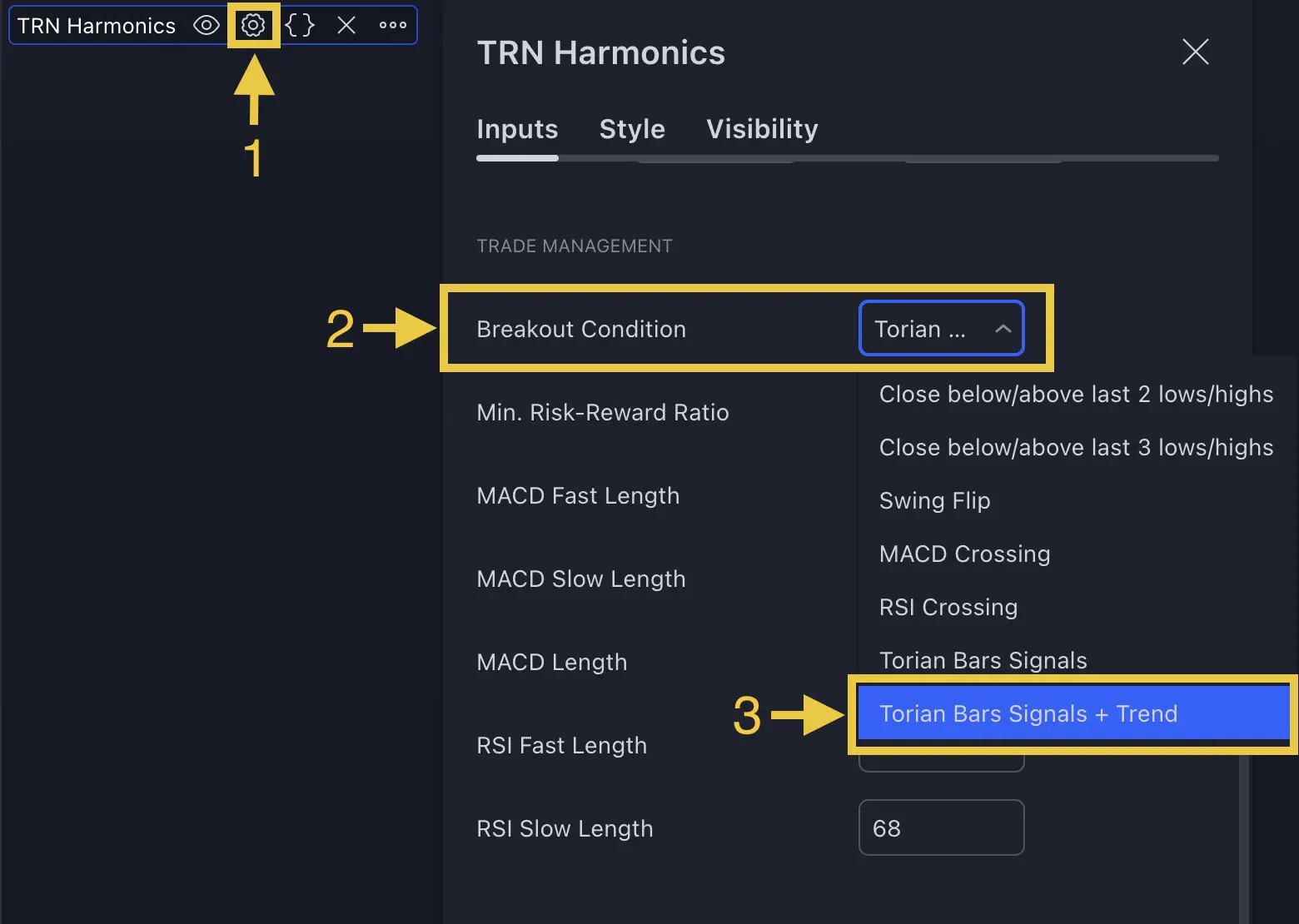
| Condition | Confirmation Level | What It Validates |
|---|---|---|
| Close Below/Above 2 Lows/Highs | Fast | Price closes beyond 2 recent swing extremes from D |
| Close 3 Lows/Highs | Moderate | Price closes beyond 3 recent swing extremes — stricter filter |
| Swing Flip | Moderate | The swing detection engine confirms a directional reversal from D |
| MACD Crossing | Moderate | MACD line crosses its signal line in the breakout direction |
| RSI Crossing | Moderate | RSI crosses a threshold level in the breakout direction |
| TRN Bars Signals | Strong | Trend Bars Pro fires a signal bar in the breakout direction |
| TRN Bars Signals + Trend (default) | Strongest | Trend Bars Pro signal bar plus confirmed trend alignment |
Choosing a Condition
The breakout condition controls how quickly you enter after a harmonic pattern completes at point D:
Faster entry (more trades, lower win rate):
- Close 2 Lows/Highs — enters as soon as price shows minor follow-through from D
- Close 3 Lows/Highs — slightly stricter but still close-based
Moderate confirmation:
- Swing Flip — waits for a confirmed structural reversal
- MACD Crossing — momentum confirmation via MACD crossover
- RSI Crossing — momentum confirmation via RSI threshold
Strongest confirmation (fewer trades, higher win rate):
- TRN Bars Signals — requires a Trend Bars Pro signal bar at D
- TRN Bars Signals + Trend — requires both a signal bar AND confirmed trend alignment
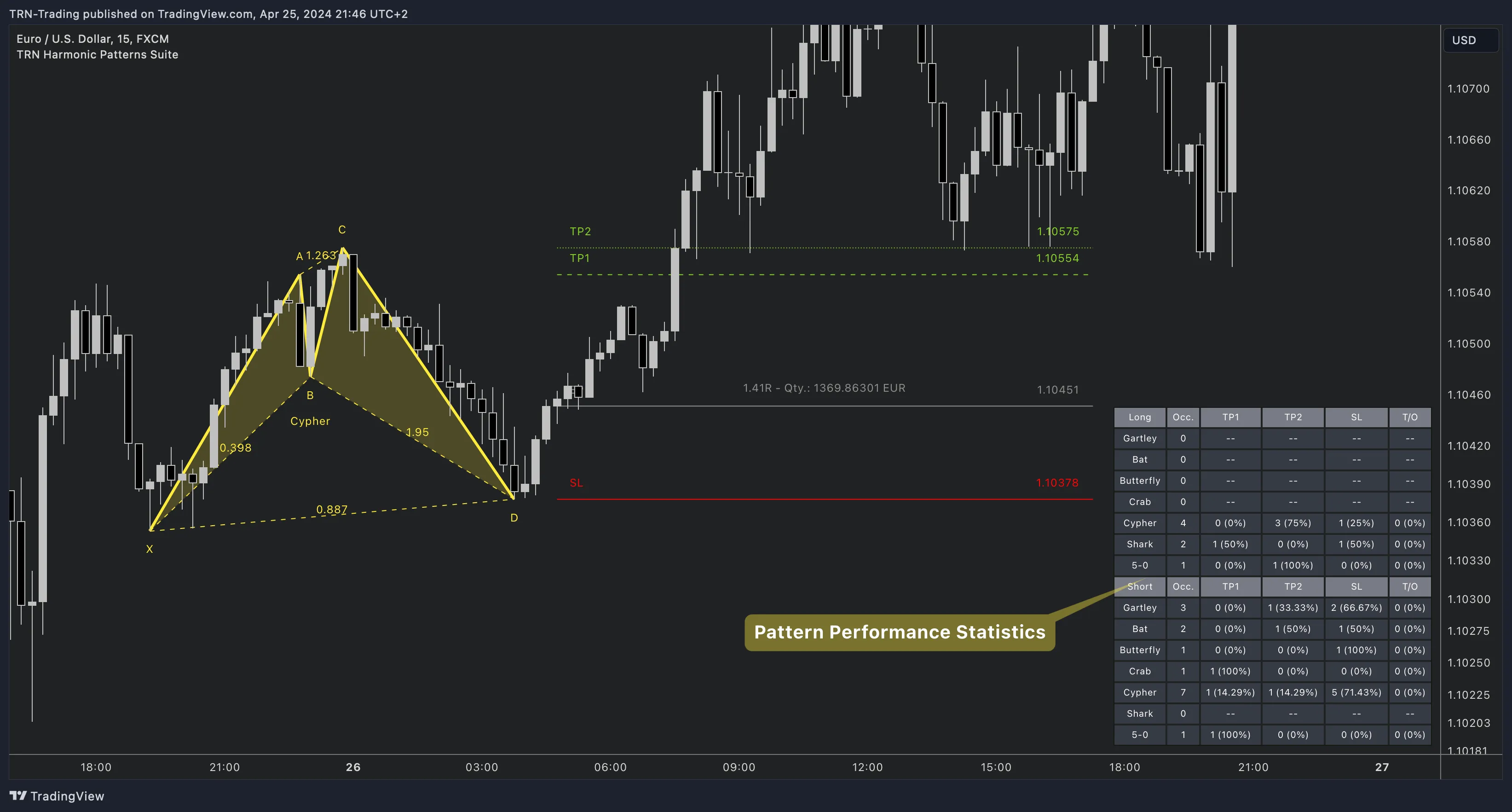
Use the Statistics table to compare breakout conditions. Switch between conditions and observe how TP1/TP2 hit rates change on your instrument and timeframe.
MACD & RSI Settings
When using MACD Crossing or RSI Crossing as the breakout condition, configurable parameters are available:
| Setting | Default | What It Controls |
|---|---|---|
| MACD Fast Length | 12 | Fast EMA period |
| MACD Slow Length | 26 | Slow EMA period |
| MACD Smoothing Length | 9 | Signal line smoothing |
| RSI Length | 14 | RSI calculation period |
| RSI MA Length | 14 | RSI moving average period |
TRN Bars Integration
The two TRN Bars breakout conditions integrate directly with Trend Bars Pro — no separate indicator setup needed. The Harmonic Patterns Suite reads Trend Bars Pro data internally.
- TRN Bars Signals — Triggers when a Trend Bars Pro signal bar (reversal or breakout) fires in the breakout direction at or near point D
- TRN Bars Signals + Trend — Requires both a signal bar AND confirmation that the Trend Bars trend direction aligns with the breakout
FAQ
How many breakout conditions does the Harmonic Patterns Suite offer?
The Harmonic Patterns Suite offers 7 independent breakout confirmation methods. Traders select one active condition at a time. The choice determines the tradeoff between earlier entry (Close 2 Lows/Highs) and higher confirmation (TRN Bars Signals + Trend).
Which breakout condition is best for harmonic patterns?
TRN Bars Signals + Trend (the default) provides the strongest confirmation but may produce later entries. Close Below/Above 2 Lows/Highs offers earlier entries with less confirmation. Use the Statistics table to compare which condition performs best on your instrument.
Can I use MACD or RSI as a breakout condition?
Yes, the Harmonic Patterns Suite includes MACD Crossing and RSI Crossing as breakout conditions. MACD uses configurable fast/slow/signal lengths (defaults: 12/26/9). RSI uses configurable length and MA length (defaults: 14/14). Both trigger when their respective signals cross in the breakout direction.
What is a Swing Flip breakout condition?
The Swing Flip condition triggers when the swing detection engine confirms a directional reversal from the D point. Swing Flip waits for a confirmed swing change rather than relying on price closes or indicator crossings, providing a structure-based confirmation method.