Head and Shoulders Statistics
Head and Shoulders Pattern includes a built-in statistics table that tracks the historical performance of detected H&S patterns on your chart. The statistics let traders validate whether their settings produce profitable reversal setups on their instrument.
Statistics Table
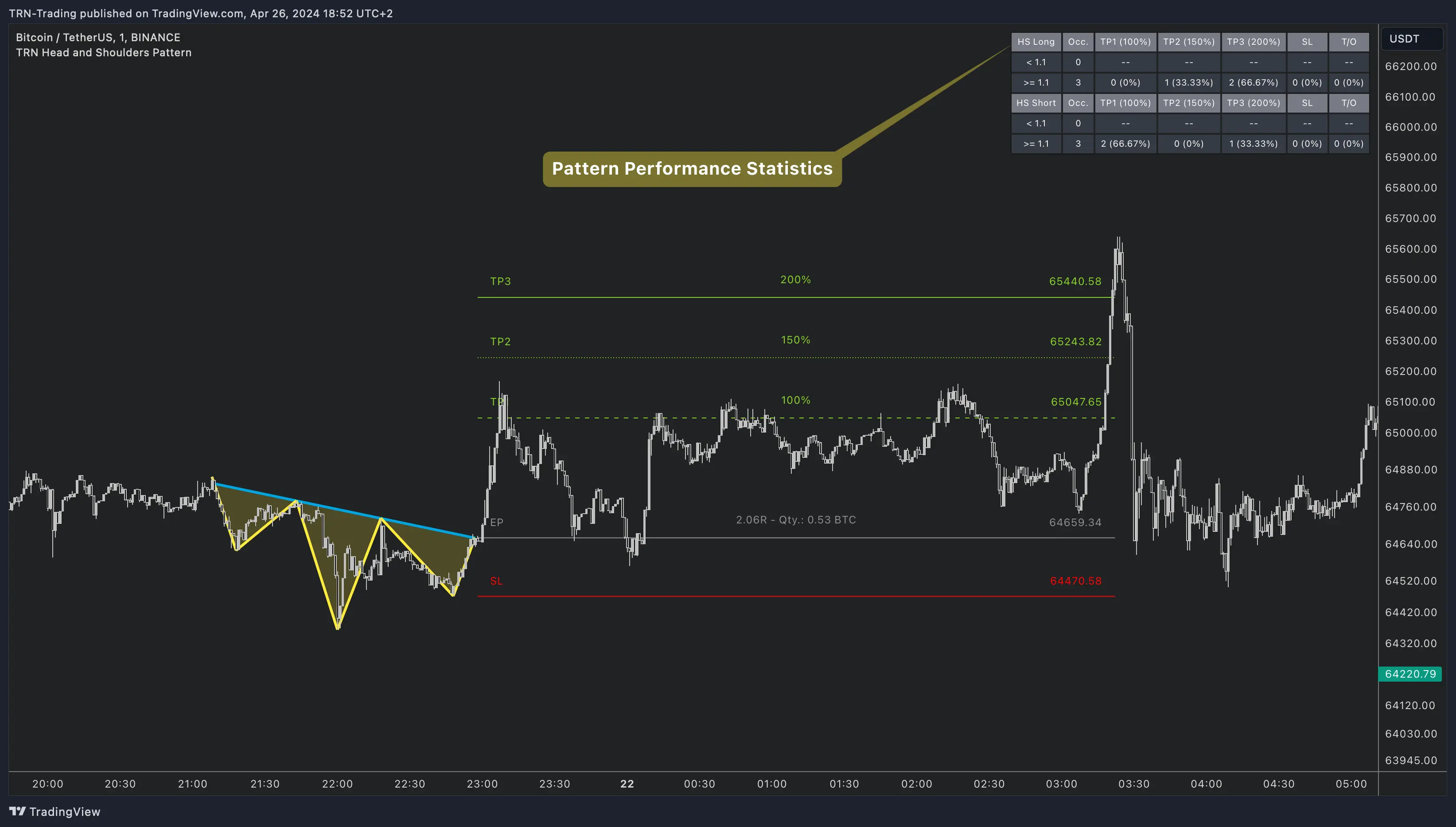
The statistics table displays performance metrics separately for long (inverse H&S breakouts) and short (classic H&S breakouts) directions.
| Column | What It Shows |
|---|---|
| Occ. | Total number of completed trades (occurrences) |
| TP1 | Trades that hit the first take profit target — count and percentage |
| TP2 | Trades that hit the second target (if enabled) — count and percentage |
| TP3 | Trades that hit the third target (if enabled) — count and percentage |
| SL | Trades that hit stop loss — count and percentage |
| T/O | Trades that expired (timed out) — count and percentage |
The statistics are further categorized by whether the trade's risk/reward ratio was above or below the minimum RR threshold. This categorization helps traders see how pattern geometry quality correlates with actual trade outcomes.
Trade Timeout
The trade timeout determines the maximum duration before a trade is automatically closed.
| Mode | Default | How It Works |
|---|---|---|
| Dynamic | Factor 3.0 | Timeout = pattern bar length x multiplier. Larger patterns get more time |
| Fixed | N/A | Absolute number of bars regardless of pattern size |
Dynamic timeout is the default and recommended mode — larger H&S formations naturally need more time for the measured move to play out.
Settings
| Setting | Default | What It Controls |
|---|---|---|
| Statistics | Off | Toggle the statistics table on or off |
| Separate Long/Short | On | Show separate rows for bullish and bearish patterns |
| Styling Preset | Dark | Table color theme — Dark or Light |
| Location | Top Right | Table position on the chart |
| Text Size | 10 | Font size for header and cell content |
| Trade Timeout | Dynamic (3.0) | Maximum trade duration mode and value |
Using Statistics to Optimize
Variables to test:
- Pattern Size — Compare different swing sizes for your instrument
- Accuracy — Test stricter vs. looser geometric constraints
- TP percentages — Adjust TP1/TP2/TP3 and compare hit rates
- Neckline mode — Compare straight vs. sloped neckline performance
- Min RR Ratio — Raise or lower the threshold and observe trade quality
Compare classic H&S (short) vs. inverse H&S (long) performance separately. Many instruments show a directional bias — H&S patterns may work better as reversals in one direction than the other.
FAQ
What statistics does the Head and Shoulders Pattern track?
The Head and Shoulders Pattern tracks occurrences, TP1 hit rate, TP2 hit rate, TP3 hit rate, stop loss hit rate, and timeout rate. All metrics are displayed separately for long (inverse H&S) and short (classic H&S) directions. An RR threshold divides trades into above and below categories.
What is the trade timeout in the Head and Shoulders Pattern?
The trade timeout determines the maximum duration before a trade is closed. The Head and Shoulders Pattern supports Dynamic timeout (scales with the pattern's bar length using a multiplier, default 3.0) and Fixed timeout (absolute number of bars). Dynamic is the default and recommended mode.
How do I use statistics to find the best timeframe for H&S patterns?
Run the Head and Shoulders Pattern on different timeframes and compare the TP1 hit rates and total occurrences. Higher timeframes typically show better TP1 hit rates but fewer patterns. Use the statistics to find the timeframe that offers the best balance of quality and frequency for your instrument.
What does the RR threshold in the statistics mean?
The statistics table divides trades by whether their risk/reward ratio is above or below the minimum RR threshold. This shows how pattern geometry quality correlates with actual trade outcomes — patterns meeting the RR threshold typically show higher TP hit rates.