Chart Patterns & Swings/Divergence
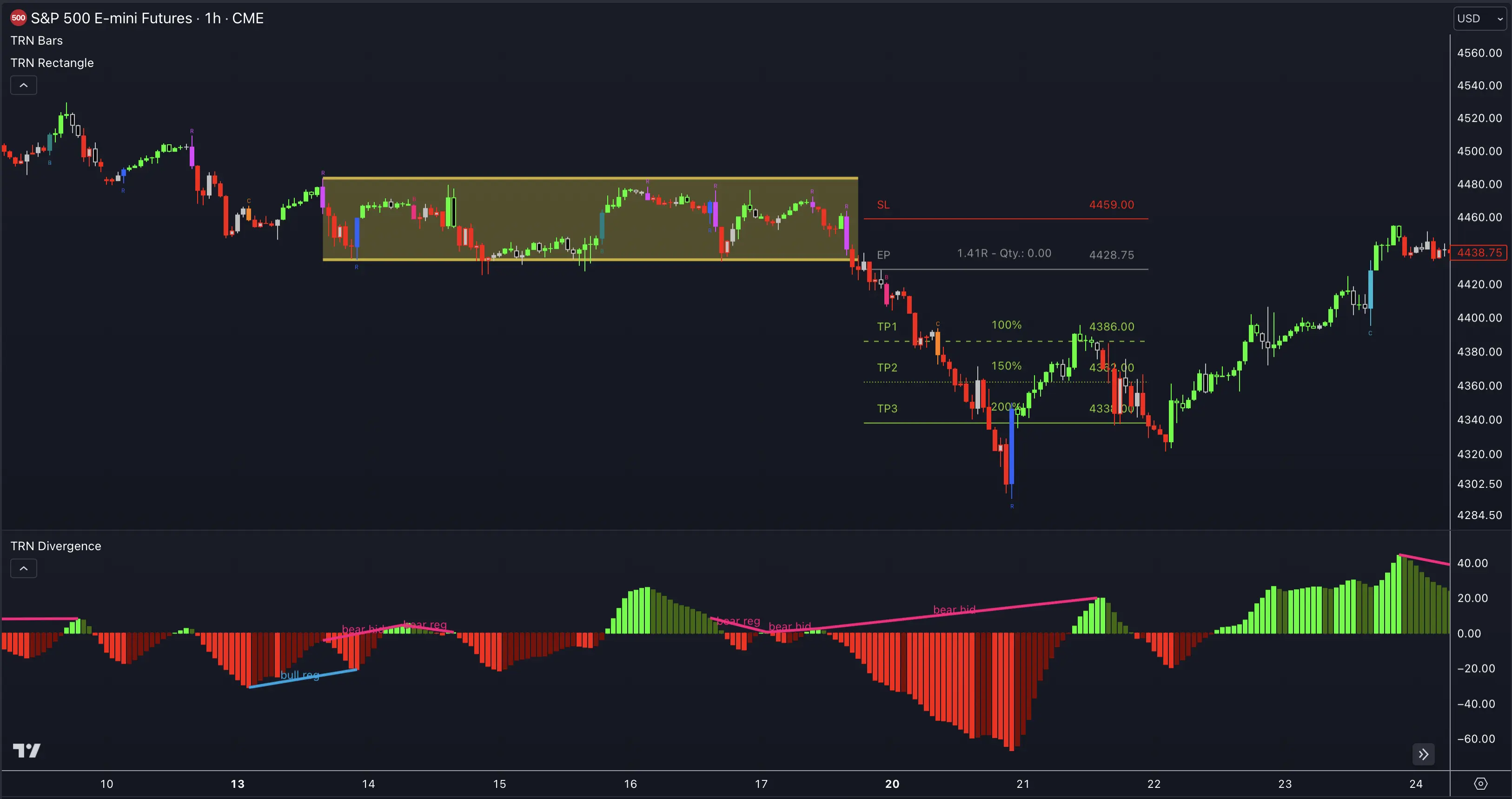
Chart patterns and oscillators provide different perspectives on price action. While chart patterns focus on visual structures and geometric formations, oscillators reveal momentum, overbought/oversold conditions, and buying/selling pressure. Combining these two approaches gives you a more comprehensive view of the market — and significantly improves the reliability of pattern-based entries.
When a chart pattern breakout aligns with a divergence signal from the SMT/Divergence Suite or the Swing Suite divergence detector, the resulting setup carries substantially more conviction than either factor alone. For example, a harmonic pattern breakout confirmed by an RSI divergence, or a consolidation breakout occurring while the MACD is above the zero line, both represent multi-factor confluence.
For ABC Pattern Pro specifically, a divergence forming near point B or point C adds conviction that the corrective wave is exhausting and a continuation move is likely.
Study the individual chart pattern sections to understand how each pattern type generates its breakout signals:
How To Use Divergences In Combination With Chart Patterns
Combining chart patterns with divergences merges two independent methods of analysis. Chart patterns provide structural context, while divergences signal potential shifts in momentum or trend direction.
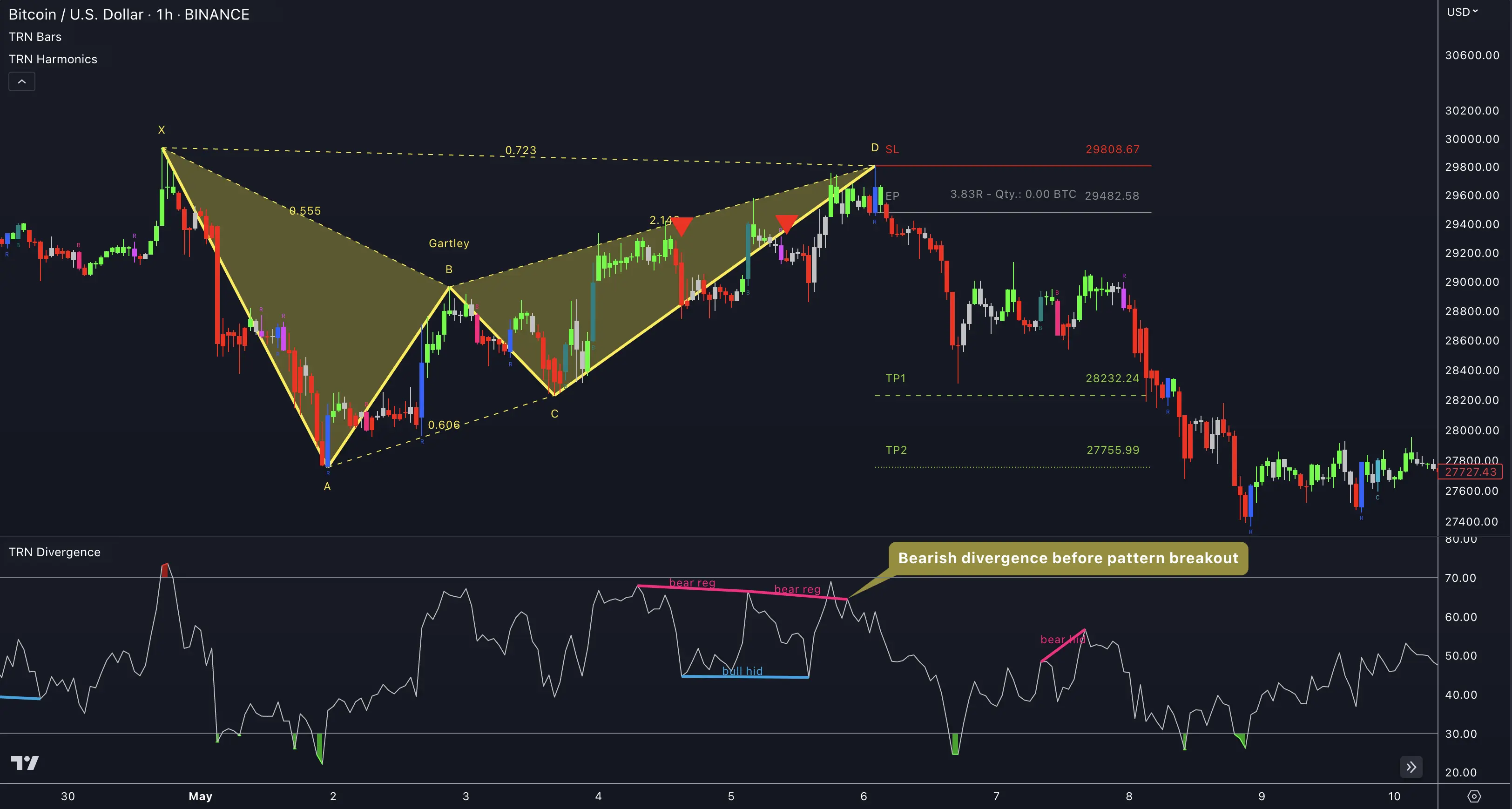
When a chart pattern experiences a confirmed breakout, the presence of a divergence with the previous swing further reinforces the signal's validity.
In the example above, the breakout from a Gartley pattern using the Harmonic Patterns Suite was confirmed after an observable bearish RSI divergence had already formed with the preceding swing. This convergence of factors adds to the signal's significance and enhances its reliability.
Visit the SMT/Divergence Suite to learn more about the 13 built-in oscillators and Smart Money Technique divergence detection. For swing-based divergence identification, see the Swing Suite divergence features.
How To Use Oscillators In Combination With Chart Patterns
The SMT/Divergence Suite contains a range of oscillators that can be combined with chart patterns. For reversal patterns, momentum oscillators such as RSI, CCI, MFI, Stochastic Oscillator, or Williams %R are most effective. Continuation patterns are better paired with trend-following oscillators such as the MACD and Awesome Oscillator, or volume oscillators such as CMF.
Reversal Patterns
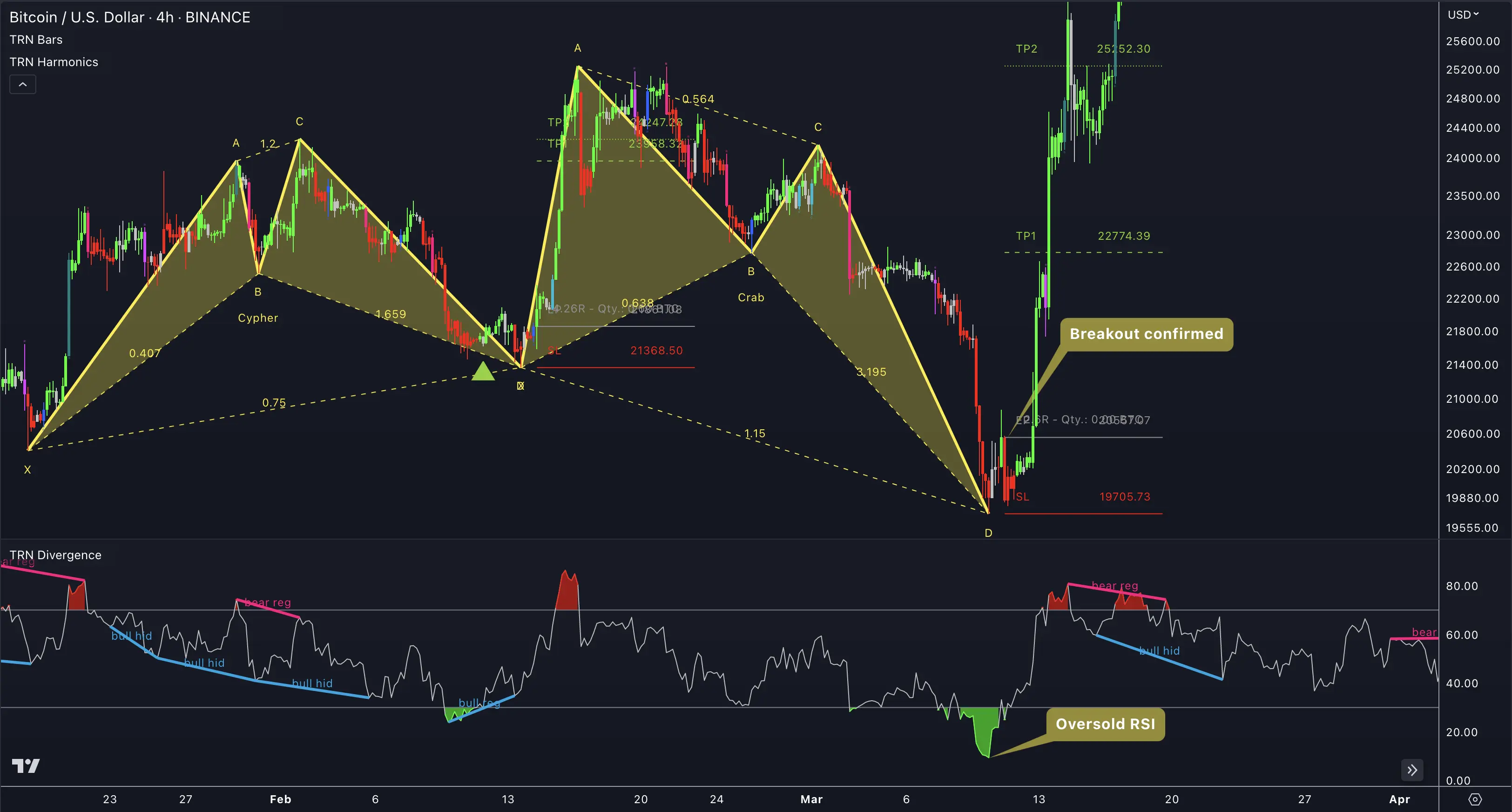
When a breakout emerges from a reversal pattern like the Harmonics, it gains credibility if it happens within the overbought or oversold region of a momentum oscillator. This occurrence acts as a confirmation of the signal's strength and validity.
In the accompanying figure, a crab pattern identified by the Harmonic Patterns Suite was validated when the Relative Strength Index (RSI) departed from the oversold zone, leading to two successful price targets. A bearish reversal signal gains similar potency when the RSI exits the overbought territory.
Continuation Patterns
When a continuation pattern is confirmed — such as a head and shoulders continuation or a rectangle breakout — you can use a momentum oscillator or trend-following oscillator (MACD, CMF, Awesome Oscillator) to confirm the signal.
If a bullish continuation pattern was confirmed while the respective oscillator was above the zero line (displayed in green), this should be considered additional validation. The same applies if the respective oscillator was below the zero line (displayed in red) while a bearish continuation pattern was confirmed.
While the signals generated by chart patterns and divergence can be valuable, they are not infallible. Many external factors affect price movement. Always consider your personal risk tolerance and investment objectives, and apply proper position sizing to every trade.
FAQ
Which oscillator works best with chart patterns?
For reversal patterns like harmonics and head and shoulders, momentum oscillators such as RSI, CCI, and Stochastic work best. For continuation patterns like rectangles and channels, trend-following oscillators such as MACD and Awesome Oscillator are more effective. The SMT/Divergence Suite includes 11 oscillators to cover both categories.
How do I confirm a pattern breakout with divergence?
Look for a divergence forming before the pattern breakout. For reversal patterns, ensure the oscillator is in overbought or oversold territory. For continuation patterns, verify the oscillator aligns with the trend direction. When a breakout occurs alongside an existing divergence, the combined signal carries significantly more weight.
How reliable are combined pattern and divergence signals?
The combination provides stronger signals than either tool alone because it requires two independent factors — pattern structure and momentum — to align. However, no trading signal is infallible. Always apply proper risk management, consider broader market context, and use the Swing Suite Statistics feature for data-driven stop-loss and target placement.
Can I use Swing Suite divergence detection for this combination?
Yes. The Swing Suite includes built-in divergence detection that works well alongside chart patterns. For deeper oscillator analysis and Smart Money Tool integration, you can add the SMT/Divergence Suite — or use both together for maximum coverage.